Württemberg

Among Germany’s major wine‑growing regions, Württemberg ranks fourth with 10,694 hectares under vine. Red grape varieties dominate the vineyards, accounting for 63 percent of plantings.
Facts
-
10.694 ha
Vineyard area (2025)
-
210
single vineyards
-
63 %
red grape varieties
Germany’s fourth‑largest red‑wine region is more closely associated than any other with the varieties Trollinger (1,614 ha) and Lemberger (1,661 ha). In addition, Pinot Noir (Spätburgunder, 1,242 ha) and Pinot Meunier (Schwarzriesling, 1,030 ha) play a significant role in red‑wine production, which covers 6,721 hectares and thus nearly two‑thirds of Württemberg’s total vineyard area. About half of all white wines in the region are made from Riesling grapes (1,995 ha).
It is well known that wine consumption in Württemberg is higher than elsewhere in Germany. Trollinger contributes greatly to this, possibly also boosted by the annual Trollinger Marathon held in Heilbronn. By contrast, Schwarzriesling, Lemberger and Spätburgunder—Württemberg’s other important red‑wine varieties - are primarily enjoyed as refined companions to sophisticated cuisine. In summer, people also appreciate a glass of Württemberger Schillerwein, a local specialty made from a blend of red and white grapes, or a glass of Riesling, the region’s most important white variety.
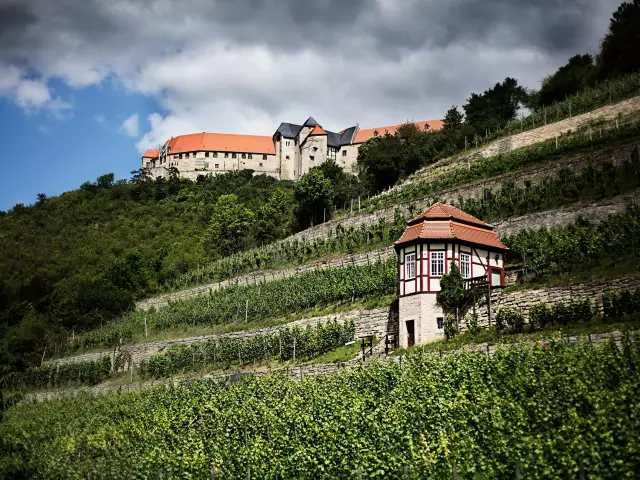
Wine is cultivated along the Neckar River as well as in the sheltered valleys of its tributaries—Rems, Enz, Kocher, Jagst and Tauber—and even on the shores of Lake Constance. The heart of the wine‑growing region is the Württembergisches Unterland in the middle Neckar area; south of it lies the Remstal‑Stuttgart district.
A large share of Württemberg’s vineyards lies in valuable steep‑slope locations. Many winegrowers work small parcels, traditionally delivering their harvest to the nearest winegrowers’ cooperative. There are more than 50 such cooperatives in Württemberg, and they market about 80 percent of the region’s wines.
Württemberg also sees itself as the land of philosophers and great poets. The first President of the Federal Republic is said to have written his speeches whilst inspired by a glass of Lemberger, and the poets Schiller and Hölderlin also found inspiration amongst the Württemberger. A visit to this region therefore, will inevitably include art and culture, such as a trip to the Schiller National Museum in Marbach, Swabia or the Hornberg Castle of Götz von Berlichingen.
Overview Württemberg
Geographical Location
Located east of the Rhine and Baden, between the Tauber Valley and the foothills of the Swabian Jura. The vineyards are situated primarily along the valleys of the Neckar River and its tributaries, the Enz and the Rems, north and east of Stuttgart.
Major Towns
Stuttgart · Heilbronn
Climate
Mild temperatures, with the Black Forest and the Swabian Jura providing natural protection. The river valleys help moderate the climate.
Soil Types
A diverse mix of soils, including shell limestone, keuper, marl, loess and clay.
Vineyard Area (2025)
10,694 ha · 6 districts · 16 collective vineyard sites · 200+ individual vineyard sites
Grape Varieties (2025)
White 37% · Red 63%
Trollinger · Riesling · Lemberger · Schwarzriesling · Pinot Noir · Müller‑Thurgau · Kerner
Marketing & Wine Estates
Four out of five growers cultivate less than one hectare of vineyards, and most are members of cooperatives. The regional cooperative cellars in Möglingen vinify around 80% of the annual harvest, including grapes supplied by 36 local cooperatives. Another 32 cooperatives produce and market their own wines. Exports play only a minor role—most wines are consumed within the region, where local customers remain remarkably loyal.
Signposted Routes Through Wine Country
- Schwäbische Weinstraße (driving)
- Weinstraße Kraichgau‑Stromberg (driving)
- Radweg Schwäbische Weinstraße (cycling)
VIDEO: Schiller meets Trollinger and Lemberger
Varietals

Highlights of wine culture in Württemberg
-
Highlight Wine Estate Burg Hornberg Götz von Berlichingen and the second oldest Wine Estate in the World
Learn more


Winesights


Wine hike Stuttgart Wine Hiking Trail
The best way to get to know the wonderful wine landscapes of Stuttgart is to explore them on the wine hiking trails.

Contact
-
Weinbauverband Württemberg e. V.
74189 Weinsberg- Hirschbergstraße 2 Baden-Württemberg Germany