Raclette & Wine

Long winter evenings and New Year’s Eve are excellent opportunities for a fondue or raclette in delightful company. The broad range of available raclettes offers a great diversity of exiting potential combinations with German wines. Wines of Germany (DWI) offers you a few guidelines for the suitable choice of wine.
Facts
-
16,738 tons
was the total production of Swiss raclette cheese in 2022
-
50 % Fat in dry matter
can be found in Raclette cheese
Raclette
Originally, Raclette is the name of a cheese from the Swiss Canton of Valais. With its nutty aromas, it is a particularly delightful side dish for jacket potatoes. Today, Raclette mostly refers to a companionable pleasure, where the guests gratinate not just potatoes, but also fresh vegetables, salami and ham or even fresh fruit with full-flavored cheese. This diversity is best accompanied by a very versatile wine such as Pinot Gris from Baden or the Pfalz. If the little pans are mostly filled with raw ham and salami, a fruity Trollinger from Württemberg or a smooth Frühburgunder from the slopes along the river Ahr are great wine companions. They accentuate the hearty character of the cheese. Raclette varieties that use fresh fruit such as pineapple or mango as well as cooked ham are very well supported by a dry Riesling from regions such as the Middle Rhine or the Hessische Bergstraße. These wines’ own fruity notes further enrich the food composition.
What does the word raclette mean?
Raclette is derived from the word "racler", which means "to scrape" in the native French dialect. Scraping for the reason that after melting over the fire, the cheese is gently scraped or "scraped" from the cheese wheel.
Varietals

More recipe ideas
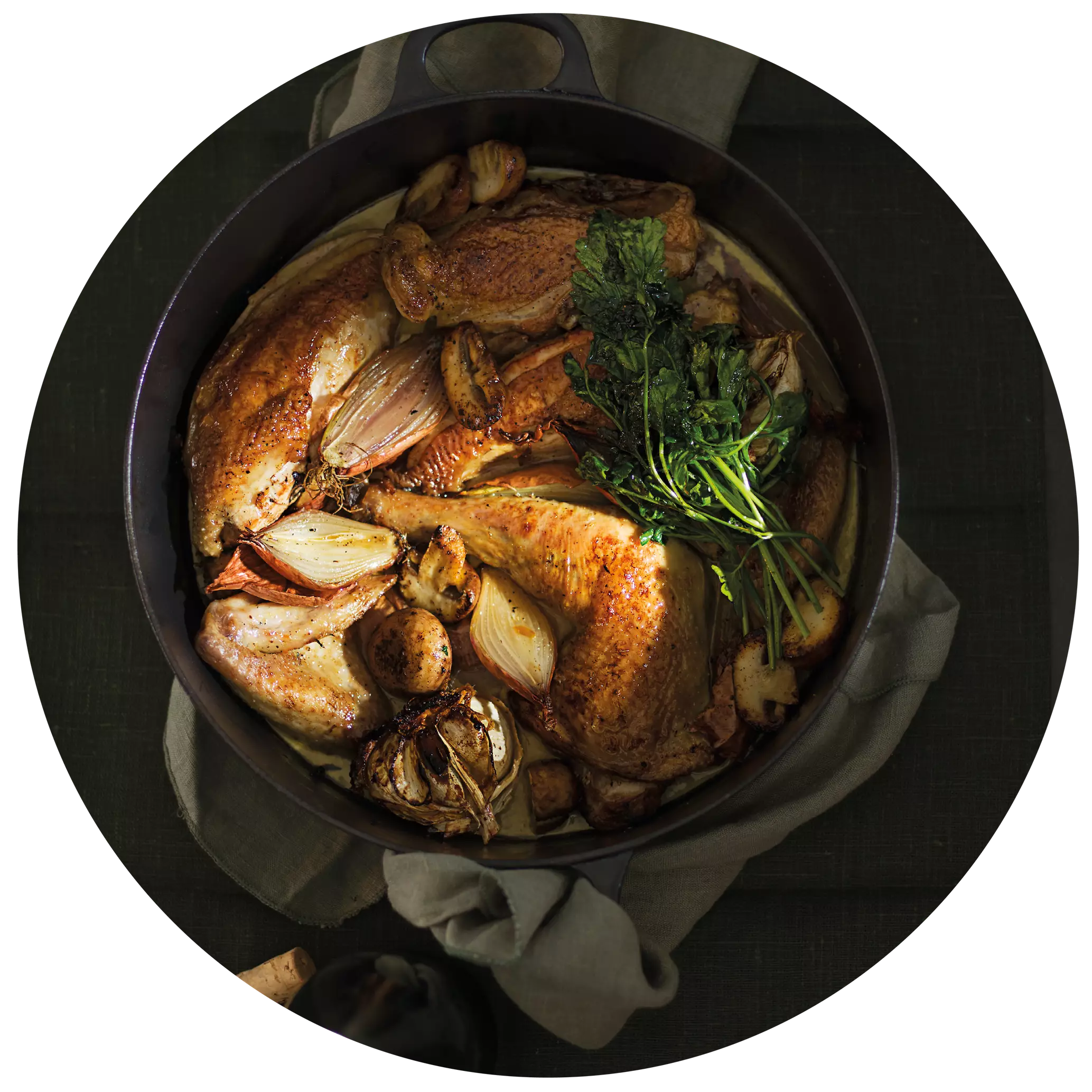
with ribbon noodles Coq au Riesling
with ribbon noodles
- 1 ganzes Huhn
- 0,4 Liter Riesling
- 0,2 Liter Sahne
- 1 kl. Glas Cognac
- 2 Stück Schalotten
- 1 Stück Knoblauchzehe
- 1 Stück Eigelb
- 1/2 Bund Petersilie
- 1 EL Mehl
- 50 Gramm Butter
- 1 EL Olivenöl
- nach Belieben Salz & Pfeffer
Carve the chicken. Heat approx. 50 g butter with 2 tbsp olive oil in a large frying pan and fry the chicken pieces until light brown (without the lid). Season lightly with salt.
Finely chop the shallots, peel and finely chop the garlic. Chop the parsley and add everything to the meat. Sauté briefly with the pan closed. Pour the cognac over the meat and light it (flambé). Deglaze with 1/3 litre of Riesling and leave to simmer for half an hour over a low heat. If necessary, add a little more wine and simmer for a further 10 minutes.
Remove the chicken pieces and keep warm for a short time. Mix 1 tbsp of flour with 1 egg yolk and the cream and whisk into the sauce. Flavour with salt and pepper. Return the chicken pieces to the pan. Serve immediately.
This goes well with tagliatelle.
Variant:Fry 150 g fresh mushrooms in 50 g butter and add.
- Riesling (trocken)
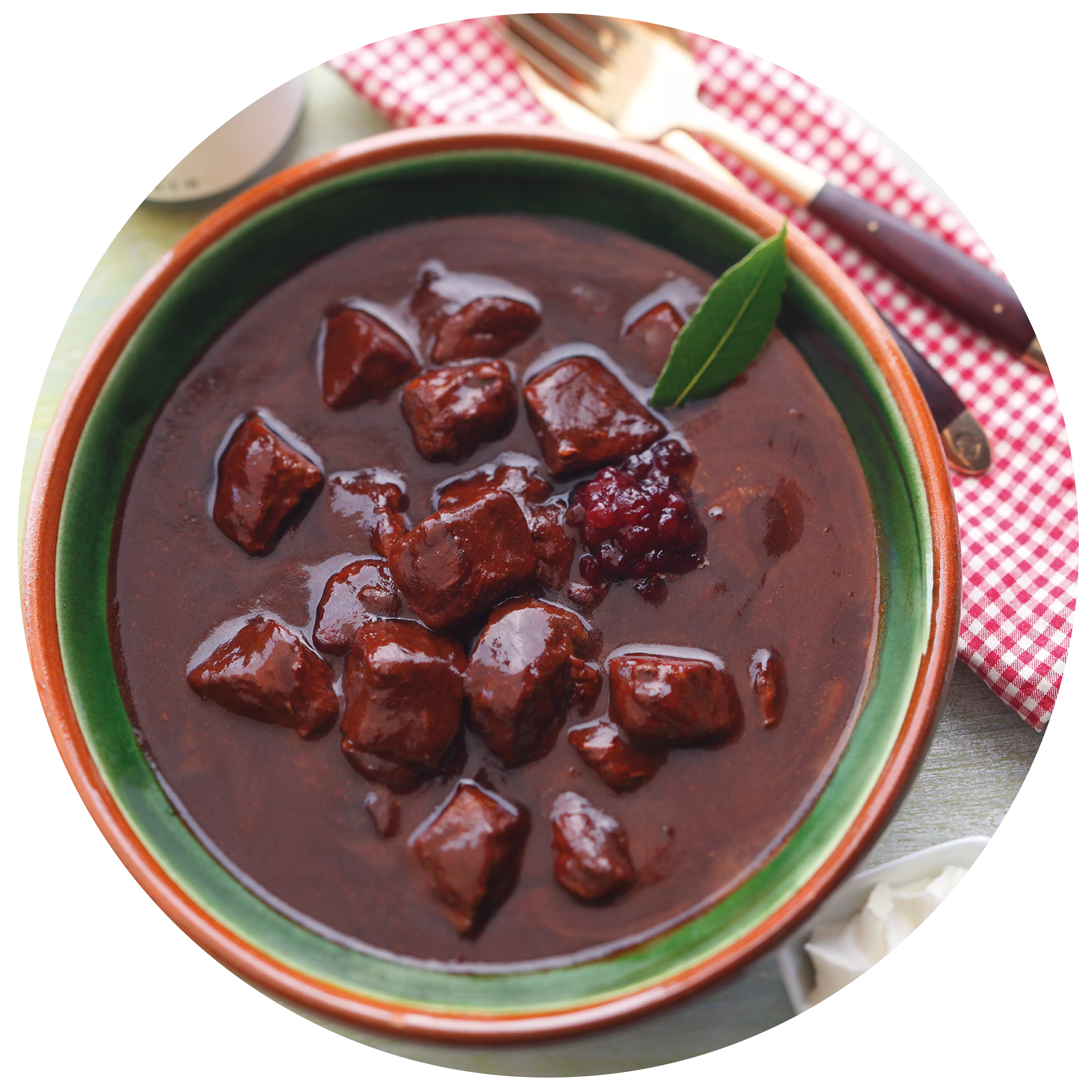
with strong red wine Wild boar ragout
with strong red wine
- 800 Gramm Fleisch vom Wildschwein (Keule o. Schulter)
- 80 Gramm Bauchspeck
- 100 Gramm Zwiebeln
- 60 Gramm Karotten
- 60 Gramm Staudensellerie
- 1 TL Tomatenmark
- 200 ml kräftigen Rotwein
- 100 ml Portwein
- 1 Liter braune Wildbrühe
- 1 TL Preiselbeeren
- 1 EL geschlagene Sahne o. Sauerrahm
- 20 Gramm Mehl
- 1 Stück Lorbeerblatt
- je 1 Zweig Rosmarin und Thymian
- 4 zerdrückte Wacholderbeeren
- 1/2 TL Senf
- nach Belieben Salz & Pfeffer
Clean and wash the vegetables and cut into evenly sized cubes.
Remove the fat, skin and tendons from the wild boar meat and cut into 3 cm cubes. Season with salt and pepper and sprinkle with flour. Heat the oil in a frying pan and brown the meat on all sides. Add the vegetables and diced bacon and fry. Add the tomato purée and stir fry. Deglaze with the red wine and port, reduce and pour in the brown game stock. Add the spices to the meat in a small spice bag and leave the ragout to simmer in the oven at 160°C for approx. 1½ hours.
Then remove the pieces of meat, remove the spices, strain the sauce, add the cranberries and mustard and leave to reduce for about 15 minutes. If necessary, thicken with a little cornflour. Serve with the whipped cream.
- Spätburgunder / Pinot Noir (trocken)
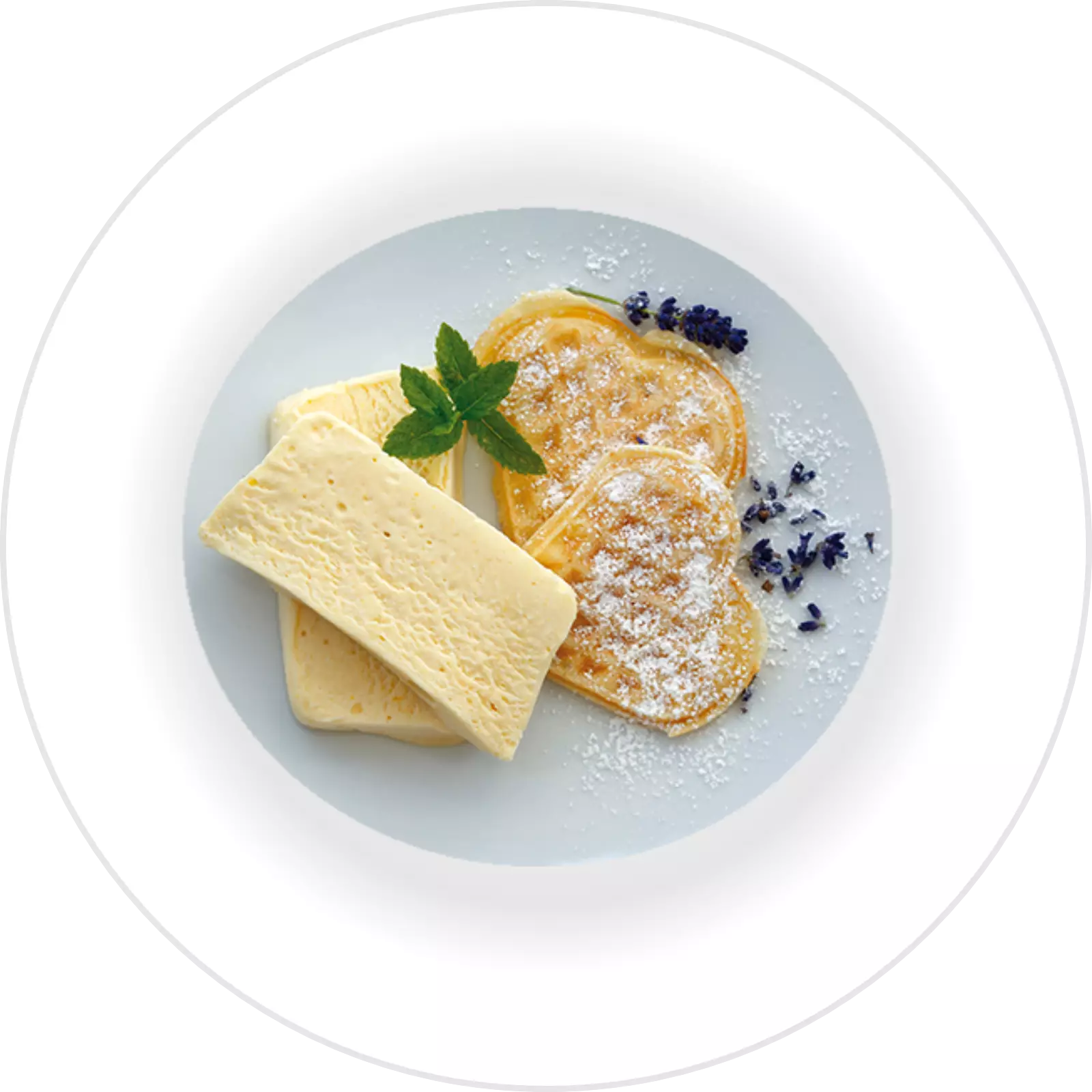
with semi-frozen goat's milk Lavender waffles
with semi-frozen goat's milk
- 2 Stück Eigelb
- 60 ml Ziegenmilch
- 500 Gramm weiße Kuvertüre
- 125 ml Sahne
- Abrieb und Saft einer halben Orange
- 2 cl Tresterbrand
- 8 Blatt Minze
- 125 Gramm Mehl
- 50 Gramm Zucker
- 70 Gramm Butter
- 2 Eier
- 1 Messerspitze Backpulver
- 1/2 EL Lavendelzucker
- 175 ml Milch
Semi-frozen goat's milk: Beat the egg yolks and goat's milk in a bowl over a hot bain-marie until creamy. Remove from the bain-marie and beat the cream until cold. Flavour with the zest of the orange and the marc brandy.
Liquefy the couverture in a bain-marie and stir into the lukewarm egg mixture. Whip the cream until stiff and carefully fold in. Line a parfait tin (triangular or gutter shape) with cling film. Pour in the mixture and smooth out. Cover well with cling film and leave to freeze in the freezer for at least 8 hours.
About 20 minutes before serving, remove the mould from the freezer and turn the parfait out of the mould. Remove the foil and cut the semi-frozen parfait into 8 slices.
<p
<p>Lavender wafers: Lightly mash the butter in a mixing bowl with a fork. Add the sugar and stir a little. Add half of the milk, the lavender sugar and the baking powder. Stir in the eggs and finally the rest of the milk. Mix everything well with a hand mixer for about 2 minutes to create a homogeneous, slightly liquid mixture. Bake the batter in batches in a waffle iron until golden brown.</p
<p>Arrange 2 slices of semifreddo on each waffle on a flat plate and decorate with mint leaves.
- Riesling (halbtrocken & feinherb)
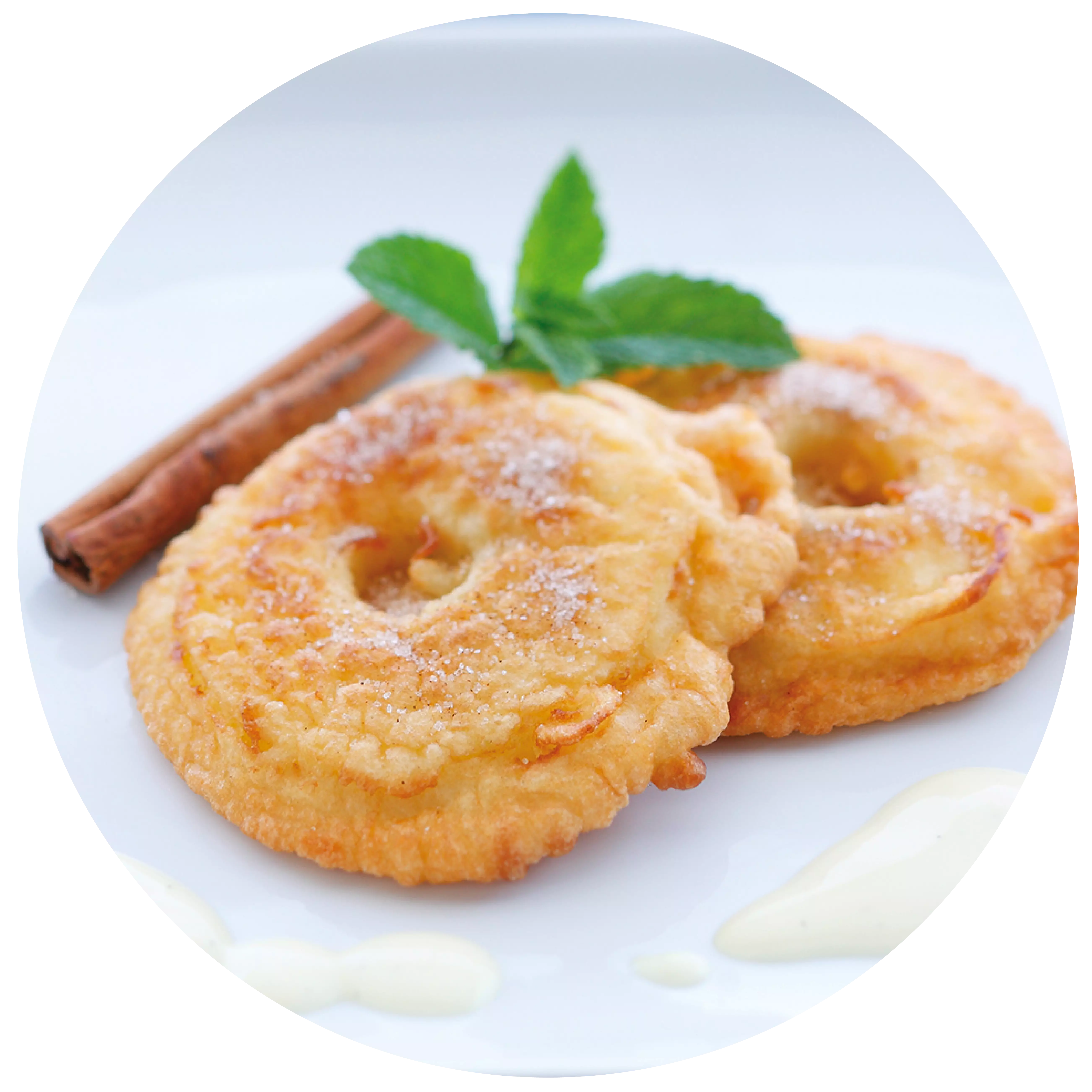
to sweet selections Apple doughnuts with vanilla sauce
to sweet selections
- 5 große, säuerliche Äpfel
- 200 Gramm Mehl
- 2 Eier
- 250 ml Milch
- 2 EL Rum
- Nach Bedarf Schmalz oder Öl
- Nach Belieben Zimt, Zucker, Salz
Peel the apples and remove the core, cut into finger-thick, even slices. Drizzle with rum and sugar. Leave to infuse.
Stir the batter, it should be quite thick. Turn the apple rings in it and bake floating in hot fat until golden brown.
<p
<p>Drain on kitchen paper and serve hot with cinnamon and sugar.
- Riesling (süß & edelsüß)
- Scheurebe (süß & edelsüß)